What Colour Windsock Do I Need?
Your complete guide to choosing the right Windsock colour for your application — from aviation to industrial safety and agriculture.
Topic
Windsock Colour Selection
Applies To
Aviation, Industrial, Agricultural
Key Standard
CASA MOS 139
Read Time
8 minutes
Aviation Standard
For aviation purposes, White is decreed for the Primary Windsock and Yellow for the Secondary Windsock. Windsocks are by regulation (CASA) 8 foot (2400mm) or 12 foot (3600mm) for larger airfields and airports as well as many pastoral airstrips.
The accepted CASA dimensions are 3600mm x 900mm diameter x Tail 250mm. For smaller airstrips 2400mm x 600 x 300. Helicopter Landing Sites are also 2400mm. Reflective Tape is now sewn on to the Tail of all our Windsocks to aid night vision.
CASA Aviation Dimensions
Primary: 3600mm × 900mm diameter × 250mm tail | Secondary: 2400mm × 600mm × 300mm
We also supply Aviation Windsocks to offshore countries who notionally follow the European format of Red/White striped Windsocks. Case in point here being Vanuatu International Airport following the French tradition.
Aviation Colour Standards
✓ White — Primary aviation Windsock
✓ Yellow — Secondary aviation Windsock
✓ Reflective tape for night visibility
✓ Red/White banded — European and offshore standard
Special Purpose Colours
Windsocks in this category range from 4 foot (1200mm) to 6 foot (1800mm) long and fall into the following colour categories;
| Colour | Primary Use | Industries |
|---|---|---|
| Yellow/Neon | Bio hazard warning, chemical/gas monitoring | Chemical, gas, workplace safety |
| Orange/Neon | Dust control, traffic safety | Construction, mining, oil and gas |
| Red | Danger warning, explosives | Defence, mining, quarries, demolition |
| White | Primary aviation wind indicator | Airports, helipads, airfields |
| Green | Pesticide drift monitoring | Agriculture, viticulture |
| Pink/Magenta | Contrast against natural backgrounds | Bushland, forests, vineyards |
| Purple | Contrast against reflective buildings | Industrial, commercial |
Industrial Colours
Yellow/Neon — Fluorescent Yellow
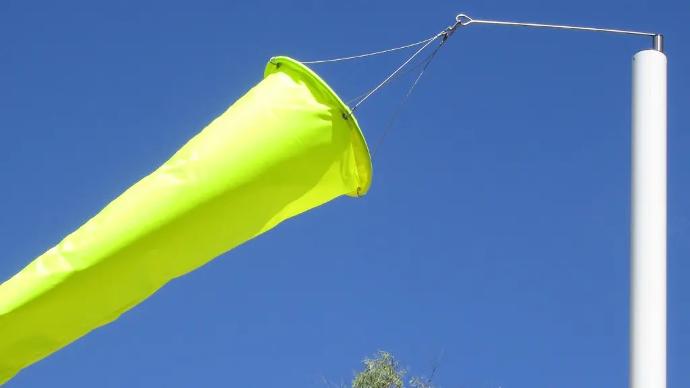
Yellow is perhaps the most visible and is useful colour when viewing the wind indicator from the ground on a cloudy day against a sky full of white or grey clouds. The colour yellow is visually seen from the furthest distance away. Yellow windsocks are suitable for hazardous gas or chemical factories or storage facilities. The colour yellow is classified as an official BIO Hazard warning colour, especially concerning workplace safety such as environmental and personnel protection from toxic or hazardous gases, chemical leaks, fumes and airborne particulates.
Key Fact
Yellow is the colour visually seen from the furthest distance away — making it ideal for hazard and safety applications.
Orange/Neon — Fluorescent Orange
Orange (a very popular colour) windsocks are generally used on building or road construction sites for dust control, additionally as a warning indicator for traffic safety. Used extensively also in the mining, oil and gas industries. The Water Corporation WA specifies either white or orange for windsock assemblies used at Water Corporation sites that store chlorine and/or ammonia.
Specialist Colours
Red Windsocks
Red windsocks are used as a warning colour on rifle ranges, at gun clubs, shooting events, mine sites, quarries, explosive detonation sites, explosive storage, fireworks displays, explosive building demolishing or in fact, for any areas that maybe dangerous to the public, work place, or work site personnel. Red windsocks are often selected by organisations for promotional purposes with contrasting white lettering which is a real standout.
Pink and Magenta Windsocks
Pink or magenta windsocks are used in or near bushland, forests, vineyards, farms, wetlands or grasslands, due to other windsock colours possible blending in with the surrounding natural backgrounds, or fruit trees, vines or shrubs when in blossom. Also for use when aerial spraying. Having said that the demand for these two colours is practically non-existent.
White Windsocks
White windsocks are used for the primary wind indicator at airports, helipads or airfields. Additionally, white fabrics are natural in colour, and hence do not fade over a long period of time. Environmental factors such as engine exhausts, factory pollution, airfield or roadside dust will contribute to discolouration. A pristine example was produced for Microflite Melbourne.
Green Windsocks
Green windsocks are used by orchardists, viticulturists, or farmers when fruit trees, vines or shrubs are in blossom for pump spray pesticide drift monitoring.
Purple Windsocks
Purple windsocks can be used where industry regulations permit or for use against light reflective building constructions, hence providing a visually solid windsock colour. Demand is very limited for purple windsocks.
💡 Choosing the Right Colour
Consider the background environment when selecting a Windsock colour. Pink or magenta works best against green bushland, while yellow stands out on overcast days against grey skies. The key is maximum contrast for visibility.
Banded Options
Banded Red/White, Orange/White, Yellow/Black and Other Colour Combinations
Banded windsocks are widely used throughout Europe and are increasing in popularity as well as being standard requirement along with Neon Orange for offshore oil and gas related vessels for helidecks as well as onshore helipads.
Banded windsocks with fluorescent night view strips either in silver or yellow are becoming more popular. This potentially saves having to illuminate the windsock. Simply shine your torch or vehicle lights on the windsock and the wind direction is instantly shown.

Colour Quick Reference
✈ Aviation
White for primary, Yellow for secondary. CASA regulated dimensions of 3600mm or 2400mm with reflective tape.
⚠ Industrial Safety
Orange for construction and mining. Yellow for chemical and gas hazards. Red for explosives and danger zones.
🌱 Agricultural
Green for orchards and viticulture. Pink or magenta for use near bushland, forests and natural backgrounds.
For further advice Contact Us. Click to take a look at our Product Range.
Key Takeaways
8+
Standard colour options available
CASA
Compliant aviation Windsocks
7
Solid colours for different industries
4+
Banded colour combinations
Custom
Colours and branding available
20+
Years of specialist experience
Why Windsocks Australia?
- Australian Made & Owned — specialist manufacturer
- CASA, marine & hazardous area compliant range
- Premium fabrics — Sunbrella, WeatherMax & High Visibility Neon
- Stainless Steel hardware for harsh environments
- Proven track record across all major industries
About Windsocks Australia
Australia's leading manufacturer of industrial Windsock systems. Designed, engineered and assembled in Australia for the harshest environments — from offshore platforms to remote mining and LNG facilities.
windsocksaustralia.com.au | info@windsocksaustralia.com.au | +61 468 474 656
Need Expert Advice on Windsocks?
Contact our team for product selection, technical specifications and custom requirements.