Windsock vs. Wind Vane: The Hidden Safety Hazard on Your Site
Many sites feature both a Wind Vane and a Windsock, on the assumption that more data is always better. But these two instruments point in opposite directions — and confusing them during an emergency evacuation can cost lives.
Topic
Safety & Compliance
Applies To
Industrial, Aviation & Mining Sites
Key Data Point
Wind Speed + Direction
Read Time
6 Minutes
A Tale of Two Instruments
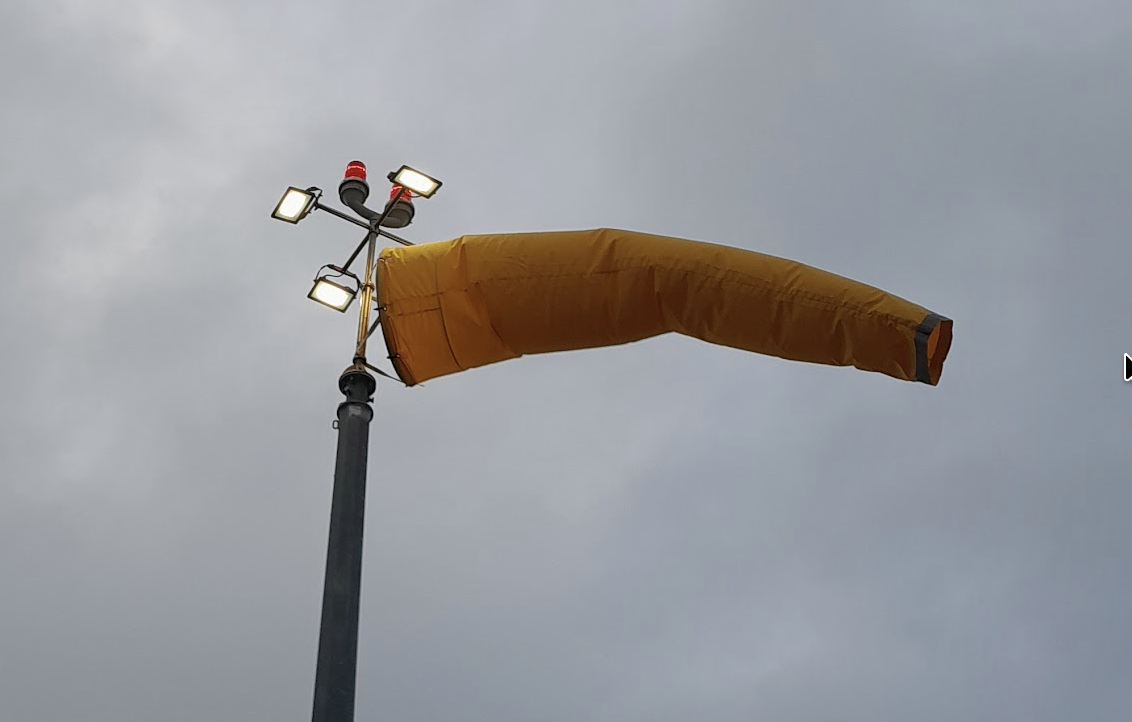
When it comes to monitoring wind on a commercial, agricultural, or industrial site, it might seem like any instrument that moves in the breeze will do the job. Many sites feature a classic Wind Vane, while others rely on a Heavy Duty Windsock. Some feature both.
Here is a truth that surprises many site managers: choosing the wrong instrument — or worse, running both together — can create a critical safety hazard during an emergency. The choice isn't about aesthetics. It's rooted in mechanics, data output, and human psychology under stress.
A One-Trick Pony
A Wind Vane tells you only the direction the wind is blowing. Whether the wind is a harmless 3 km/h breeze or a raging 60 km/h gale, a Wind Vane looks exactly the same.
The Speed Component: Why Windsocks Win
A standard industrial or aviation Windsock is engineered to react precisely to wind speed. Its conical design gives a trained eye two crucial data points at a single glance — direction, and speed. A Wind Vane rotates purely on a horizontal plane and provides no speed data at all, in any conditions.
Size plays its part too. A Windsock is typically double or triple the physical size of a standard Wind Vane, which makes a substantial difference in visibility from a distance. On a large industrial, mining, or airport site, a small rotating arrow can be almost impossible to make out from hundreds of metres away — while a full-scale, high-visibility Windsock is designed to be seen and read at a glance from across the site.
⚠ A Wind Vane Only Tells Half the Story
In high-risk environments like helipads, mines, or chemical plants, knowing the speed of the wind is just as vital as knowing its direction. A Wind Vane cannot provide this.
Which Way Does Each One Point?
This is the detail that catches most site managers off guard. A Windsock and a Wind Vane point in completely opposite directions.
Windsock
Points Downwind
Acts like a flag. The tail shows where the wind is travelling to.
Wind Vane
Points Upwind
The arrow tip shows where the wind is coming from.
Same Wind, Opposite Signals
If the wind is blowing East, the Windsock points East — and the Wind Vane arrow points West. Same wind. Opposite directions on the instrument.
The Evacuation Safety Paradox
Deploying a Wind Vane and a Windsock on the same site is a genuine workplace health and safety hazard. In an emergency evacuation scenario — a chemical spill, a gas leak, or a bushfire — the golden rule of survival is to evacuate upwind, moving into the wind so the hazard is carried away from you.
Under extreme stress, the human brain loses cognitive flexibility. If a worker looks up and sees a Windsock pointing East and a Wind Vane pointing West, cognitive dissonance stalls their decision-making. A split-second delay, or a misinterpretation of which instrument does what, can send someone running downwind — directly into a toxic plume or a fire front.
⚠ Why This Is a WHS Hazard
During a real evacuation there is no time for a physics debate. Conflicting instruments on the same site create exactly the kind of split-second confusion that costs lives.
Head-to-Head Comparison
| Feature | Windsock | Wind Vane |
|---|---|---|
| Primary Mechanics | Truncated fabric cone on a 360° swivel | Asymmetrical pointer balanced on a vertical pivot |
| Directional Indicator | Points with the wind (downwind) | Points into the wind (upwind) |
| Speed Indication | Yes — angle and inflation estimate speed | None — 0 knots of speed data, ever |
| Visibility | High-visibility colours for long-range viewing | Often metallic, low-profile or ornamental |
| Typical Size | Double to triple the size of a Wind Vane | Compact — often hard to spot from a distance |

The Verdict: One Clear Signal Saves Lives
During a site evacuation, there is no time for a physics debate. Everyone on site needs one clear, unmistakable visual indicator that they understand instantly.
Because a Windsock offers high-visibility colours, instant wind speed estimation, and a natural, intuitive movement pattern, it is the gold standard for industrial and aviation site safety. If your site currently features a mix of Wind Vanes and Windsocks, it's time to streamline your safety assets — remove the conflicting signal, and stick to the instrument that gives the full picture at a single glance.
Key Takeaways
3 Knots
Windsock begins to move
15 Knots
Fully inflated, horizontal
0
Speed data from a Wind Vane
Downwind
Direction a Windsock points
Upwind
Direction a Wind Vane points
1
Clear signal per site — never both
Why Windsocks Australia?
- Australian Made & Owned — specialist manufacturer
- CASA, marine & hazardous area compliant range
- Premium fabrics — Sunbrella, WeatherMax & High Visibility Neon
- Heavy Duty Frames and Poles for harsh environments
- Proven track record across all major industries
About Windsocks Australia
Australia's leading manufacturer of industrial Windsock systems. Designed, engineered and assembled in Australia for the harshest environments — from offshore platforms to remote mining and LNG facilities.
windsocksaustralia.com.au | info@windsocksaustralia.com.au | +61 468 474 656
Need to Streamline Your Site's Wind Safety Assets?
Contact our team for product selection, technical specifications and custom requirements.